Andromeda Galaxy (M31)

Joshua Tree National Park - August/September 2023

The Andromeda Galaxy is a barred spiral galaxy and is the nearest major galaxy to the Milky Way. It was originally named the Andromeda Nebula and is cataloged as Messier 31M31, and NGC 224. Andromeda has a D25 isophotal diameter of about 46.56 kiloparsecs (152,000 light-years)[8] and is approximately 765 kpc (2.5 million light-years) from Earth. The galaxy's name stems from the area of Earth's sky in which it appears, the constellation of Andromeda, which itself is named after the princess who was the wife of Perseus in Greek mythology.[8]

The virial mass of the Andromeda Galaxy is of the same order of magnitude as that of the Milky Way, at 1 trillion solar masses (2.0×1042 kilograms). The mass of either galaxy is difficult to estimate with any accuracy, but it was long thought that the Andromeda Galaxy was more massive than the Milky Way by a margin of some 25% to 50%.[11] However, this has been called into question by early 21st-century studies indicating a possibly lower mass for the Andromeda Galaxy[11] and a higher mass for the Milky Way.[12][13] The Andromeda Galaxy has a diameter of about 46.56 kpc (152,000 ly), making it the largest member of the Local Group of galaxies in terms of extension.[13]
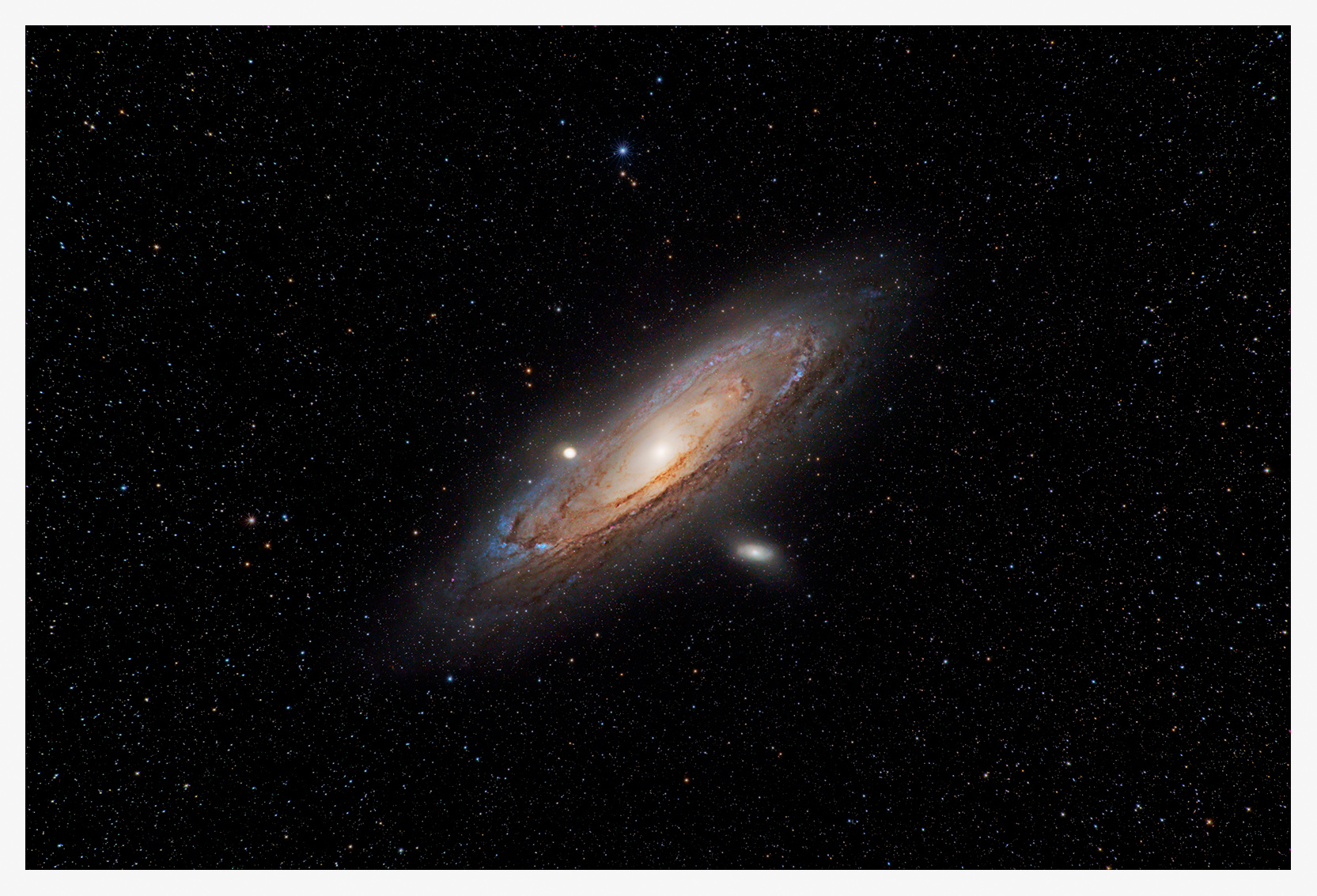
The Milky Way and Andromeda galaxies are expected to collide with each other in around 4–5 billion years,[14] merging to potentially form a giant elliptical galaxy[15] or a large lenticular galaxy.[16]

With an apparent magnitude of 3.4, the Andromeda Galaxy is among the brightest of the Messier objects,[17] and is visible to the naked eye from Earth on moonless nights,[18] even when viewed from areas with moderate light pollution.[8]